Persian Desserts: 7 Must-Try Sweets & Where to Find Them
Quick Answer: Persian desserts are built on saffron, rosewater, cardamom, and pistachios rather than heavy chocolate or frosting. The seven most beloved are sholeh zard (saffron rice pudding), baghlava, faloodeh (rosewater noodle sorbet), bastani sonnati (saffron ice cream), zoolbia and bamieh (syrup-soaked fritters), gaz (pistachio nougat), and saffron halva. You can taste all seven at Persian bakeries and ice cream shops across the U.S. — many of them listed right here on Iranian Business Center.
Most people meet Persian food through kabob and saffron rice. The desserts are where the culture actually shows off. A Persian sweet is rarely just sugar: it is perfume, color, and memory ,the smell of rosewater at a wedding, the gold of saffron at Nowruz, the halva a family cooks together to honor someone they lost.
This guide walks you through the seven desserts worth seeking out first, what each one tastes like, when Iranians actually eat it, and where to find the real thing near you.


What Makes Persian Desserts Different
Persian sweets run on four signature ingredients:- Saffron — the world’s most expensive spice, used for color and a honeyed, floral depth
- Rosewater — distilled rose petals; the signature perfume of Persian pastry
- Cardamom — warm and citrusy, Persia’s answer to cinnamon and vanilla
- Pistachios and almonds — for crunch, richness, and that unmistakable green-on-gold look
1. Sholeh Zard (Saffron Rice Pudding)
Sholeh zard is rice slow-cooked with sugar, saffron, rosewater, and cardamom until it turns a deep golden yellow, then decorated with cinnamon, slivered almonds, and pistachios — often in patterns or words drawn across the surface. What makes it special is how it is shared. Sholeh zard is the classic nazri — a food cooked in large pots and given away to neighbors and strangers as an act of gratitude or remembrance. Many Iranian Americans will tell you their strongest food memory is a bowl of sholeh zard handed to them from someone’s doorway. Tastes like: a silky rice pudding where saffron, not sugar, is the star.2. Baghlava (Persian Baklava)
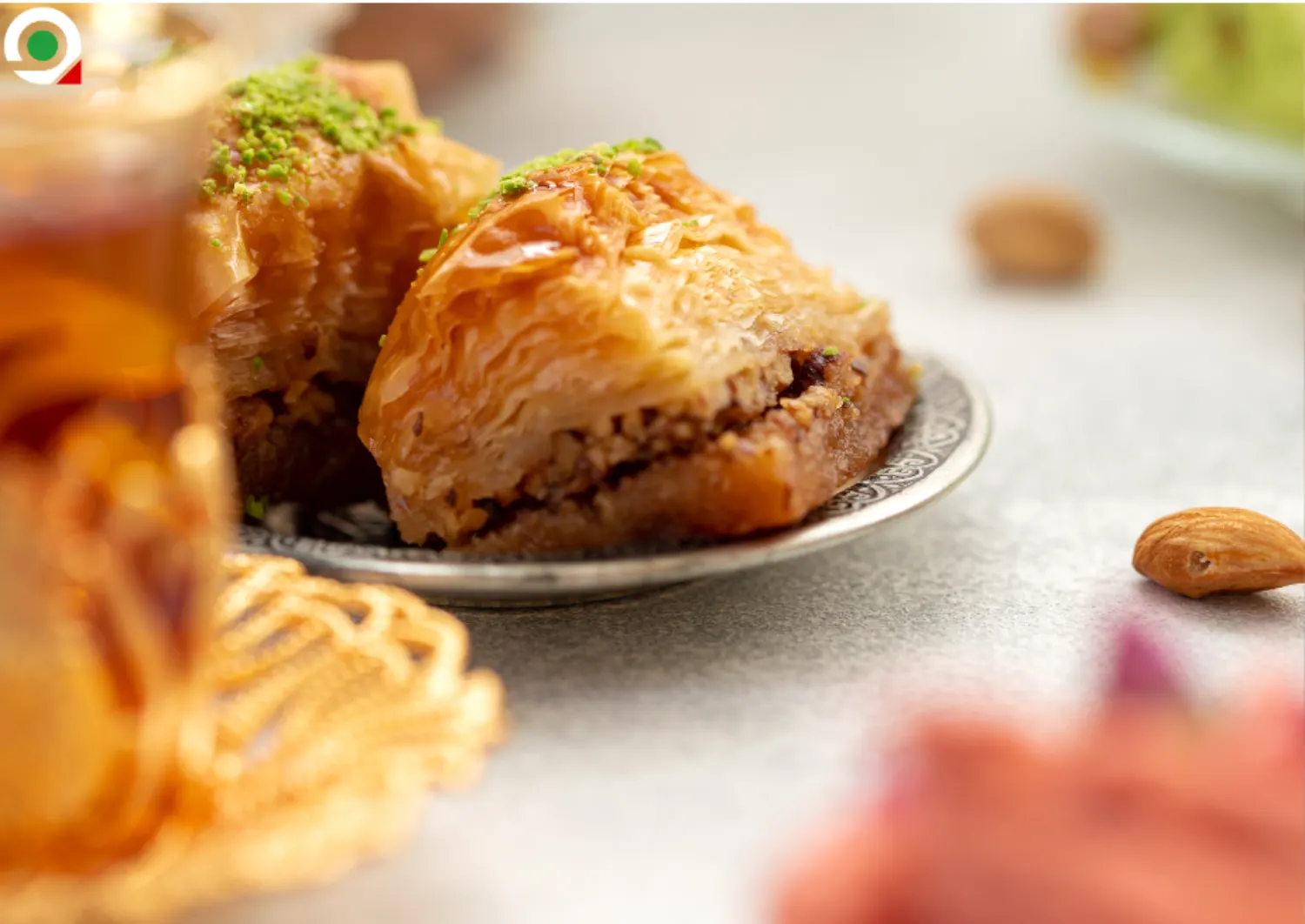
Persian baghlava shares a name with its Turkish cousin but not a personality. The Persian version — the famous ones come from Yazd and Qazvin — is cut into small diamonds, packed with ground almonds and pistachios, scented with cardamom, and finished with a light rosewater syrup. It is more delicate and less syrup-drenched than the baklava most Americans know. Tastes like: cardamom and pistachio first, honeyed pastry second — rich, but in small, precise bites.
3. Faloodeh (Rosewater Noodle Sorbet)
Faloodeh is often described as one of the world’s oldest frozen desserts, with roots reaching back to ancient Persia. Thin rice-starch noodles are frozen into a rosewater sorbet and served with fresh lime juice — or, if you order it like a local, a pour of sour cherry syrup. The original comes from Shiraz, and “faloodeh Shirazi” is still the name to look for on menus. Tastes like: a frozen rose lemonade with a texture unlike anything else in the dessert world — cold, chewy, and shockingly refreshing after a heavy meal.4. Bastani Sonnati (Persian Saffron Ice Cream)
Iran’s traditional ice cream is flavored with saffron, rosewater, and pistachios, with one detail that makes first-timers fall in love: frozen flakes of pure cream folded through every scoop. Many menus call it Akbar Mashti, after the legendary Tehran ice cream maker whose early-1900s shop made the style famous. Order it sandwiched between two thin wafers — bastani noni — or ask for the classic combo: a scoop of bastani next to a serving of faloodeh. Tastes like: the entire Persian flavor palette — saffron, rose, pistachio, cream — in one scoop.5. Zoolbia and Bamieh (Saffron Syrup Fritters)
Zoolbia are lacy, deep-fried spirals; bamieh are small golden ovals. Both are soaked in a saffron-honey-rosewater syrup and sold side by side, especially during Ramadan, when they are the iftar sweet across Iran. They are crisp, sticky, and made to be eaten with hot tea — the bitterness of the tea against the syrup is the whole point. Tastes like: if a donut and honey baklava had a crispier, more fragrant child.6. Gaz (Persian Pistachio Nougat)
Gaz is the pride of Isfahan: a soft white nougat traditionally made with a natural sweet sap called angebin, whipped with egg whites and rosewater and studded with pistachios. It comes dusted in flour or wrapped in elegant boxes — because gaz is, above all, a gift. Bringing a box of gaz when you visit someone’s home is Persian hospitality in physical form. Tastes like: a chewier, more floral nougat with serious pistachio density.
7. Saffron Halva
Persian halva is nothing like the crumbly sesame halva of the Mediterranean. Wheat flour is slowly toasted in butter until deep amber, then worked into a glossy, dense paste with saffron-rosewater syrup and pressed into a dish, decorated with pistachios and coconut. It carries real emotional weight: halva is cooked for memorials and religious occasions, and families often make it together. It is comfort food in the most literal sense. Tastes like: toasted, buttery caramel with a floral finish — small portions, big flavor.How Persians Serve Dessert
One rule unlocks all seven: Persian desserts live next to tea. Strong black tea, served in small glasses, is poured all day in Iranian homes — and sweets are set beside it rather than served as a separate course after dinner. If you are trying Persian desserts for the first time, order the tea too. The slight bitterness is the intended backdrop for every sweet on this list. Two pairings locals swear by:- Bastani + faloodeh in one bowl — the classic ice cream shop order
- Zoolbia-bamieh + fresh-brewed tea — the Ramadan standard
Where to Find Persian Desserts in the U.S.
The good news: you do not need a flight to Tehran. Persian bakeries, ice cream shops, and markets operate across the country, with the largest clusters in California, Texas, and the New York area. The fastest way to find the real thing near you is to browse the Iranian Business Center directory:- Explore [Iranian restaurants and bakeries] [LINK → Restaurants & Bakeries category page]
- Browse Persian businesses by region: [California] [LINK → /region/california/], [Texas] [LINK → /region/texas/], [New York] [LINK → /region/new-york/]
- Curious about the culture behind the food? Start with our guide to [Persian culture] [LINK → /persian-culture/]