How to Identify an Authentic Persian Rugs USA
You fall in love with a rug at a local shop, the seller swears it is hand-knotted in Iran, and the price feels almost too good to be true. That feeling of doubt is your instinct working correctly. The global rug market is flooded with machine-made imitations, and knowing the difference between a genuine heirloom and a clever copy can save you thousands of dollars and decades of regret.
This guide walks you through every practical test, every warning sign, and every question you should ask before spending a single dollar on a Persian rug in 2026. Whether you are a first-time buyer or a seasoned collector, these insights will sharpen your eye and protect your investment.
What Makes a Persian Rug Truly Authentic?
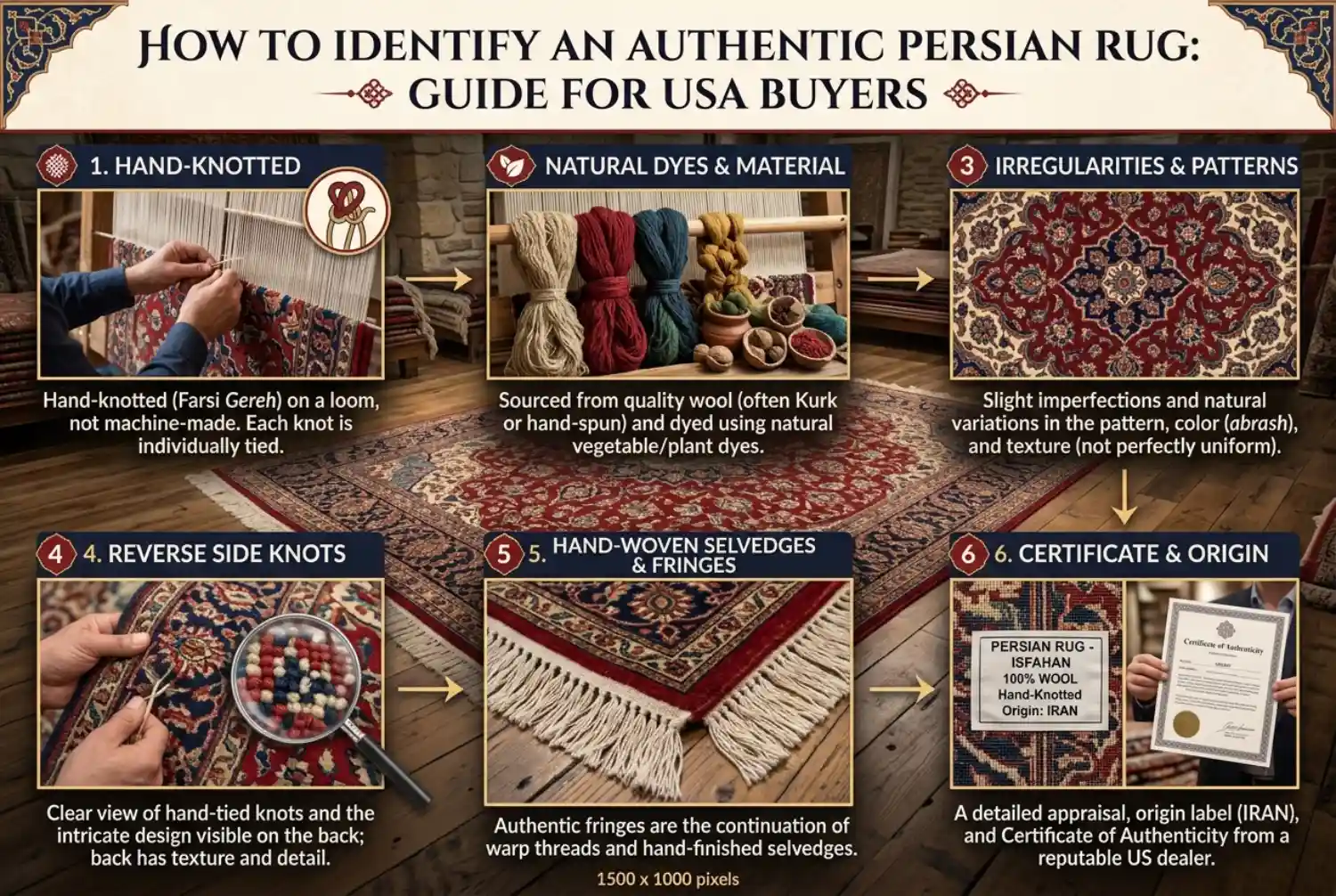
Quick Answer: An authentic Persian rug is hand-knotted by skilled artisans in Iran using natural wool, silk, or cotton, featuring traditional regional designs passed down through generations. No two genuine pieces are exactly identical. The word “Persian” is not just a style label. It refers specifically to rugs produced in Iran, a country with more than 2,500 years of documented rug-weaving history. Iran once dominated the global handmade rug trade its exports peaked at over $2 billion in the mid-1990s but decades of sanctions have sharply reduced the flow of authentic Iranian rugs to Western markets, while India now leads global handmade carpet exports with roughly 40 percent of the trade. That scarcity is exactly why counterfeit “Persian” labeling has become such a persistent problem: genuine Iranian pieces are harder to source, and mislabeled imitations rush in to fill the demand. Regional origin defines authenticity more than any single design element. A Tabriz rug from northwestern Iran carries dense geometric medallions and typically uses a Turkish double knot, while a Kashan rug from central Iran favors floral arabesques and a Persian single knot. A Qom (Qum) piece, often made entirely of silk, represents the pinnacle of fine weaving. Each region has a distinct visual language, and genuine dealers can trace a rug to its city or even its weaving workshop. If a seller cannot tell you where in Iran a rug was made, treat that as a serious red flag. Authentic rugs also carry the weight of human imperfection. Slight variations in color gradation, known as abrash, appear naturally when weavers switch between different batches of hand-dyed yarn. A perfectly uniform color field across a large rug almost always signals machine production. Look for those subtle shifts; they are signs of life, not flaws.
What is Abrash? Abrash refers to the natural, irregular color variations found within authentic handmade Persian rugs. These subtle tonal shifts occur because artisans dye wool in small batches, and slight differences between dye lots create gentle gradations across the rug’s surface. Rather than being a defect, abrash is a celebrated hallmark of genuine hand-knotted craftsmanship and actually increases a rug’s collector value over time.
Physical Tests for Authentic Persian Rugs USA Buyers Should Know
Quick Answer: Fold the rug back to expose the knots, check for a soft and slightly uneven backing, and rub a damp white cloth on the pile. Natural dyes will not bleed significantly, while synthetic dyes often transfer color immediately. Before any money changes hands, get hands-on with the rug. Fold a corner of the rug back on itself. On an authentic hand-knotted piece, you will see individual knots on the back, and the pattern on the reverse will mirror the front almost perfectly, though slightly less crisp. A machine-made rug typically has a canvas or latex backing applied to hold the pile in place, and the reverse will look uniform and flat rather than textured. According to the Rug and Textile Appreciation Museum, machine-made rugs represent over 60 percent of rugs sold in the United States, meaning most buyers encounter far more fakes than genuine pieces without realizing it. Run your palm firmly across the pile in one direction, then the other. Wool from Iranian sheep, particularly from highland regions, has a lanolin-rich feel that is simultaneously soft and resilient. Synthetic fibers, including polypropylene and viscose, tend to feel slippery or artificially shiny. Viscose, sometimes marketed as “art silk” or “bamboo silk,” is especially deceptive because it photographs beautifully but crushes flat within months of regular foot traffic. The fringe test is one of the quickest authenticity checks available. On a genuine hand-knotted Persian rug, the fringe is an extension of the warp threads that form the rug’s structural foundation. Gently pull one fringe strand while pressing your fingers against the pile nearby. You will feel resistance because the fringe is structurally connected. On a machine-made rug, fringe is almost always sewn or glued on as decoration. Tug firmly and it often pulls away from the body of the rug with little resistance.Knot Count, Materials, and What to Expect to Pay
Quick Answer: Knot density is measured in knots per square inch (KPSI), and a quality hand-knotted Persian rug typically ranges from 80 to over 800 KPSI depending on origin and material. Price ranges vary widely from around $500 per square foot for fine wool pieces to several thousand dollars per square foot for pure silk Qom rugs. Knot density directly correlates with the level of detail in a rug’s design and the number of hours a weaver invested. Tribal rugs from regions like Gabbeh or Qashqai often register between 40 and 120 KPSI, featuring bold, loose geometric patterns that reflect a nomadic aesthetic. City rugs from Tabriz, Isfahan, or Kashan typically range from 150 to 400 KPSI. Fine Nain or Qom silk rugs can exceed 800 KPSI, requiring years for a single weaver to complete. A simple way to estimate knot density without tools is to count the knots along one inch of the back of the rug horizontally, then vertically, and multiply the two numbers. Material authentication matters as much as knot count. Genuine Persian rugs use wool, silk, or cotton warps and wefts. A quick burn test, done responsibly with a small pulled fiber, distinguishes natural from synthetic. Natural wool chars, smells like burning hair, and produces a crushable ash. Synthetic fibers melt, bead up, and smell like burning plastic. Many reputable dealers encourage buyers to ask for this test or to request a laboratory fiber analysis certificate for high-value purchases. The American Society for Testing and Materials (ASTM) publishes standards for textile fiber identification that certified appraisers use in formal authentication. Pricing gives context. In 2026, a genuine hand-knotted Persian wool rug measuring 8 by 10 feet in good condition typically retails between $2,500 and $12,000 depending on age, provenance, and knot density. Fine silk pieces of the same size from premium weaving centers can command $15,000 to $80,000 or more at auction. If a seller is offering a “hand-knotted Persian silk rug” for $400, the price itself is the authentication test. Deals that defy market logic almost always defy authenticity as well. For buyers in the United States looking to connect with trustworthy sources, browsing verified Iranian rug dealers listed on the Iranian Business Center provides access to sellers whose credentials and community reputation are publicly visible.Where to Buy: Finding Verified Iranian Rug Dealers
Quick Answer: Purchase from dealers with verifiable Iranian heritage, professional appraisals, and transparent provenance documentation. Avoid auction house generics, big-box retailers, and sellers who cannot answer specific regional origin questions. Knowing what to look for is only half the equation. Knowing where to shop safely is equally important. Iranian-owned rug businesses bring generational expertise that no amount of sales training can replicate. Many dealers come from families with direct ties to weaving workshops in Tabriz, Isfahan, or Mashhad. That background means they can read a rug the way a sommelier reads a wine, identifying not just what it is but roughly when and where it was made, sometimes even by which family. When evaluating a dealer, ask for a written bill of sale that specifies country of origin, approximate age, primary materials, and knot type. Ask whether the dealer offers independent appraisals and whether they have relationships with certified appraisers recognized by the American Society of Appraisers. Legitimate dealers welcome scrutiny because their inventory stands up to it. Online purchases require additional caution. Request multiple high-resolution photographs of the rug’s front, back, fringe, and any areas of wear or repair. Ask for a video walkthrough. Reputable dealers will also provide return policies measured in weeks, not days, giving you time to have a piece independently assessed. Platforms like the Iranian Business Center’s Persian Stores directory list vetted Iranian-owned businesses across the United States, making it easier to find sellers with accountable community standing rather than anonymous online storefronts. If you are undertaking home renovation or restoration alongside a rug purchase, pairing your investment with trusted interior guidance helps protect it. Checking resources like Iranian construction and home services professionals can connect you with flooring and interior experts who understand how to properly display and preserve a high-value rug.
Key Takeaways:
- Authentic Persian rugs are hand-knotted in Iran and carry specific regional identities such as Tabriz, Kashan, Isfahan, or Qom. Regional origin is the foundation of authenticity.
- Physical tests including the fringe pull, fold-back knot inspection, damp cloth dye test, and fiber burn test are reliable, immediate ways to separate genuine pieces from imitations.
- Knot density (KPSI) and material quality determine price. A suspicious price is itself a major red flag; genuine high-quality Persian rugs carry real market value that cannot be dramatically undercut without compromising authenticity.
- Natural color variations called abrash are a celebrated sign of handmade authenticity, not a defect. Uniformly perfect coloring in a claimed handmade rug is cause for skepticism.
- Always purchase from dealers who provide written provenance documentation, accept independent appraisals, and have verifiable professional or community credentials. Iranian-owned dealerships listed on trusted directories offer accountability that anonymous sellers cannot match.
Why Choose Iranian Business Center
The Iranian Business Center is the dedicated digital platform connecting Persian entrepreneurs with customers across the United States. For rug buyers, that means access to a curated network of Iranian-owned dealerships, appraisers, and home service professionals whose reputations are tied to a real community rather than anonymous listings.- Verified Iranian-Owned Businesses: Every listing on the platform represents a real business with community accountability. Browse authentic Persian rug dealers near you with confidence that sellers have been vetted through a trusted Iranian business network.
- Broad Category Coverage: Beyond rugs, find Iranian professional services including appraisers, interior consultants, and legal experts who can support high-value purchases from evaluation through acquisition.
- Local and National Reach: Whether you are searching in a major metropolitan area or a smaller market like Ohio, the platform surfaces Iranian-owned businesses at the local level so you can shop with community trust no matter where you are located.
- SEO Visibility for Business Owners: If you own a rug dealership, gallery, or related service, listing on the Iranian Business Center puts your business in front of thousands of active buyers searching for authentic Persian products in 2026.
- Community and Cultural Alignment: The platform exists to strengthen the Iranian business community across America, creating a trusted ecosystem where buyers and sellers share cultural values around quality, craftsmanship, and fair dealing.
Ready to get started? List Your Business and Get Discovered by Thousands of Iranian Customers
Frequently Asked Questions
How can I tell the difference between a hand-knotted and a machine-made Persian rug?
Fold the rug back and examine the reverse side. A hand-knotted rug shows individual knots tied around warp threads, and the pattern on the back mirrors the front with slight softening. A machine-made rug typically has a smooth, uniform backing, often with a canvas or latex layer applied to anchor the pile. The fringe on a genuine rug is structurally part of the rug itself, not sewn or glued on. Additionally, look for subtle color variations called abrash across the pile surface; these appear naturally in handmade pieces because dye batches vary slightly between dyeing sessions.What is a fair price range for authentic Persian rugs in the USA in 2026?
Prices vary significantly based on age, regional origin, knot density, material, and condition. A new or semi-antique hand-knotted Persian wool rug in a standard 8 by 10 foot size typically retails between $2,500 and $12,000 from reputable dealers in the United States. Fine silk rugs from weaving centers like Qom can range from $15,000 to $80,000 or more for the same size. Tribal rugs such as Gabbeh or Bakhtiari tend to be more affordable, starting around $800 to $2,500 for smaller sizes. Any price dramatically below these ranges for a claimed high-quality authentic piece should prompt immediate skepticism and additional verification.Are natural dyes important for authenticity, and how do I test for them?
Natural dyes are strongly associated with traditional Persian rug production and are considered a quality marker, particularly in antique and high-grade pieces. Historically, colors were derived from plant and insect sources including pomegranate rinds, indigo, madder root, and kermes. A reliable field test involves pressing a dampened white cloth firmly against the pile and rubbing. Natural dyes produce minimal to no transfer. Synthetic chemical dyes, especially lower-quality ones, often bleed noticeably onto the cloth. For formal purchases, a professional dye analysis by a textile conservator provides definitive results and is worth requesting for any rug priced above $5,000.What regional origins produce the most valuable authentic Persian rugs?
Several Iranian weaving cities are internationally recognized for producing exceptional rugs. Qom (also spelled Qum) produces the finest silk rugs in the world, with knot counts exceeding 800 KPSI in the most refined examples. Isfahan and Kashan are renowned for perfectly balanced floral designs and premium wool quality. Tabriz, one of the oldest weaving centers, produces a wide range including both commercial and museum-quality pieces. Nain rugs feature extraordinarily fine wool and silk highlights on cream or ivory grounds. For tribal and nomadic character, pieces from the Qashqai, Bakhtiari, and Kurdish weavers carry bold geometric energy and considerable collector appeal. Each region commands its own price premium based on current collector demand.What documents should a reputable rug dealer provide at the point of sale?
A trustworthy dealer should provide a detailed written bill of sale specifying the country of origin (Iran), the approximate age or production period, the primary materials used in pile, warp, and weft, the type of knot (Persian single knot or Turkish double knot), the approximate knot density, and any known restoration or repair history. For pieces valued above $3,000, an independent appraisal certificate from an appraiser credentialed by the American Society of Appraisers adds significant protection. Some dealers also provide a certificate of authenticity from weaving cooperatives or export documentation from Iran. Keep all paperwork safely stored, as provenance documentation directly affects resale and insurance value.Can I find authentic Persian rugs online safely, or should I only buy in person?
Both channels can be safe when approached correctly. In-person shopping allows for immediate physical testing, which is a significant advantage. Online purchasing from established Iranian-owned dealers with verifiable business histories, transparent return policies, and high-resolution documentation can also be reliable. Request detailed photographs of the rug’s front, back, all four edges, fringe, and any worn or repaired sections. Ask for a video walkthrough showing the texture and pile depth. Confirm that the dealer offers a return window of at least 14 days so you have time for an independent appraisal. Buying through platforms like the Iranian Business Center rug dealer directory connects you with businesses that have community accountability rather than anonymous online storefronts.How do I find Iranian rug dealers near me in the United States?
The most reliable approach in 2026 is to use a dedicated Iranian business directory that lists verified, community-vetted dealers. The Iranian Business Center maintains a searchable directory of authenticated Persian rug dealers across the USA, organized by location and specialty. You can also check with local Iranian cultural centers, Persian community associations, and regional art fair networks. For professional support including appraisers and interior consultants who specialize in Persian textiles, the Iranian local services directory offers additional verified contacts. Attending Iranian cultural events and exhibitions in your area also surfaces reputable dealers who are active in the broader Iranian-American community.What is the difference between a Persian rug and an Oriental rug?
The terms are related but not interchangeable. “Oriental rug” is a broad category that includes hand-knotted rugs from any country in the traditional rug-producing belt, encompassing Turkey, Afghanistan, Pakistan, India, China, and the Caucasus region, as well as Iran. “Persian rug” refers specifically to rugs woven in Iran. All Persian rugs are Oriental rugs, but not all Oriental rugs are Persian. The distinction matters for valuation and authenticity purposes because the term “Oriental” is sometimes applied loosely by sellers to machine-made or non-Iranian pieces in order to imply a heritage connection that does not exist. Always ask explicitly about country of origin and request documentation rather than relying on category labels alone.Iman Baktash
SEO, PPC, Social Media Marketing, Google My Business Optimization, SMS Marketing, AI Marketing, Web Design, App Development, Content Writing, Graphic Design, and Branding all under one roof.
Iman Baktash is a digital marketing expert and the founder of Danabak, a full-service digital marketing agency. With deep expertise in SEO, PPC, social media marketing, Google My Business optimization, SMS marketing, and AI-powered marketing strategies, Iman helps businesses grow their online presence and drive real results. His mission is simple deliver high-quality digital solutions at affordable prices that make a difference.
Take Action Today
Buying an authentic Persian rug is one of the most rewarding investments a homeowner or collector can make. A genuine hand-knotted piece appreciates in value over time, grows more beautiful with age, and carries the living history of Iranian craftsmanship directly into your home. The key is knowing what to look for and who to trust before you commit your money. Here are the most important steps to take before your next purchase:- Perform the fold-back knot test, the fringe pull test, and the damp cloth dye test on any rug you are seriously considering.
- Ask the dealer to specify the exact regional origin within Iran and to explain the design tradition associated with that region.
- Request a written bill of sale with all material and provenance details, and for any piece above $3,000, request an independent appraisal from an American Society of Appraisers credentialed expert.
- Shop with verified Iranian-owned dealers who have community accountability. Use the Iranian Business Center rug dealer directory to find trustworthy sources near you.
- If you need professional support for displaying or caring for your rug, connect with Iranian home and construction service professionals who understand how to protect a valuable textile investment.